![[Translate to English:] Transition énergétique · Amplitude 2030](/fileadmin/_processed_/e/7/csm_PROVENCE_03_DIGITAL_e42930dcb9.png "[Translate to English:] Transition énergétique · Amplitude 2030")
AT THE SOURCE OF CHANGE
Energy, decarbonization, climate change adaptation and biodiversity: these issues are profoundly transforming our airport. They have become commitments, reflected in tangible actions that our teams carry out every day on the ground.
–78%
in greenhouse gas emissions since 2013*
20%
of electricity needs now covered by solar panel generation
330
hectares of areas of ecological interest
45%
improvement in energy performance per square metre since 2010
OVERVIEW OF OUR RECENT ACTIONS
Having launched major transition projects and established an organisation and working methods, we are now developing tangible initiatives designed to deliver lasting benefits.
![[Translate to English:] -](/fileadmin/_processed_/3/f/csm_bg-sun_08d3cbdca4.png "[Translate to English:] -")
Reducing Our Carbon Footprint
The airport is a major hub for businesses and people. Our direct responsibility accounts for less than 1% of the airport’s total carbon footprint. That does not prevent us from acting on the levers we control or can influence.
Energy
We have improved our energy performance per square metre by 45% since 2010, with a further 10% improvement over three years thanks to our new heating and cooling plant, as part of ISO 50001 certification obtained in 2021 and renewed in 2024.
Transport
It accounts for 12% of the airport’s carbon footprint. We are bringing mobility stakeholders together to develop public transport and the future cable-car link from Vitrolles Aéroport Marseille Provence railway station.
SAF
84% of the carbon footprint relates to the landing and take-off cycle and half of the cruise phase. We support the development of SAF and e-SAF by facilitating their distribution on our platform, with 2% locally supplied SAF in 2025. These are not our direct emissions, but we have a responsibility to support our partners’ transition.
Building resilience to climate change
Heatwaves, heavy rainfall, droughts… In response to the increasing frequency of intense climate events, we have drawn up an Adaptation Plan for 2026–2035. It structures our approach around five priorities.
#1
Water management: greening, reduction of sealed surfaces and a water conservation plan.
#2
Infrastructure maintenance and development: incorporating the vulnerability assessment from the design stage, conducting exposure studies for climate hazards and adapting maintenance plans.
#3
Adapting work to climate change: adapting workspaces, uniforms and processes, and updating prevention plans.
#4
Adapting the passenger journey to heat: creating cool areas, installing water points and supporting passengers.
#5
Strategic coherence: financial projections, procurement policy, business continuity planning and the decarbonisation pathway.
PROTECTING LIVING SYSTEMS
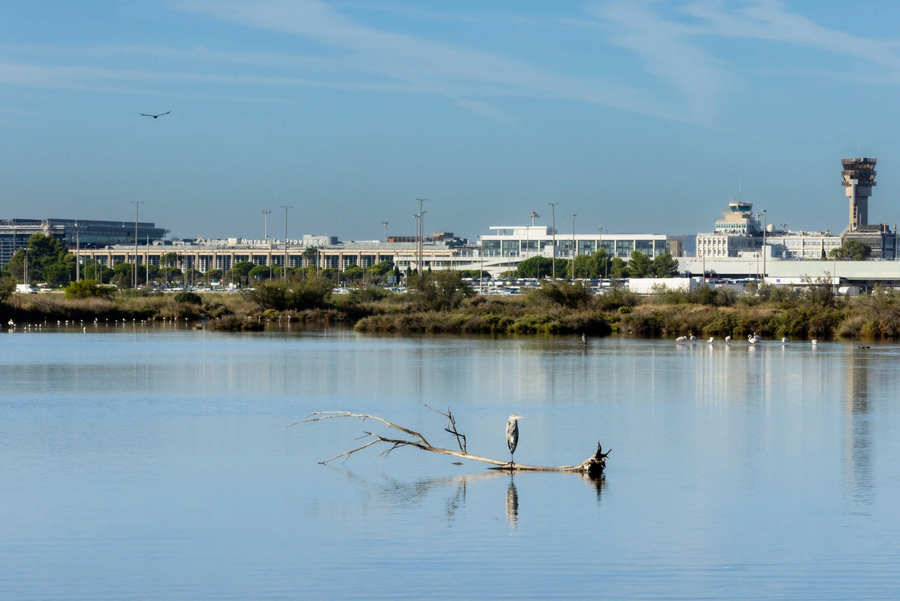
An airport is rarely expected to address this issue. And yet, just minutes from the runways, flamingos, storks and little bustards coexist with airport operations. We are mindful of this and work to protect them.
Biodiversity
The French Bird Protection League, LPO, has been supporting us since 2025 in surveying and protecting the species present. We also work with the Aérobiodiversité association, which develops biodiversity observation and monitoring programmes at airports. Membership of the association is aligned with the objectives of France’s National Biodiversity Strategy 2030. In 2025, the airport contributed to a programme led by the Conservatoire d’espaces naturels and the Rhône-Alpes Region to reintroduce the little bustard at a former military site.

Green spaces
We maintain more than 330 hectares of vegetated areas, including two Natural Areas of Ecological, Fauna and Flora Interest, known as ZNIEFFs. In addition to initiatives carried out at the airport, we aim to develop more than 5,000 m² of green spaces in public areas over the next five years. Since 2022, the entire site has been maintained without the use of plant protection products, building on an approach launched in 2019 in the landside areas.

Wildlife hazard management
In accordance with aviation safety requirements, the airport assesses wildlife presence on and around the platform in order to reduce the risk of collision. This management is based primarily on monitoring, habitat management and targeted, proportionate deterrence measures, taking account of the species present and biodiversity considerations.