The New P3 Parking Facility Tells a Much Broader Story Than a Simple Parking Solution
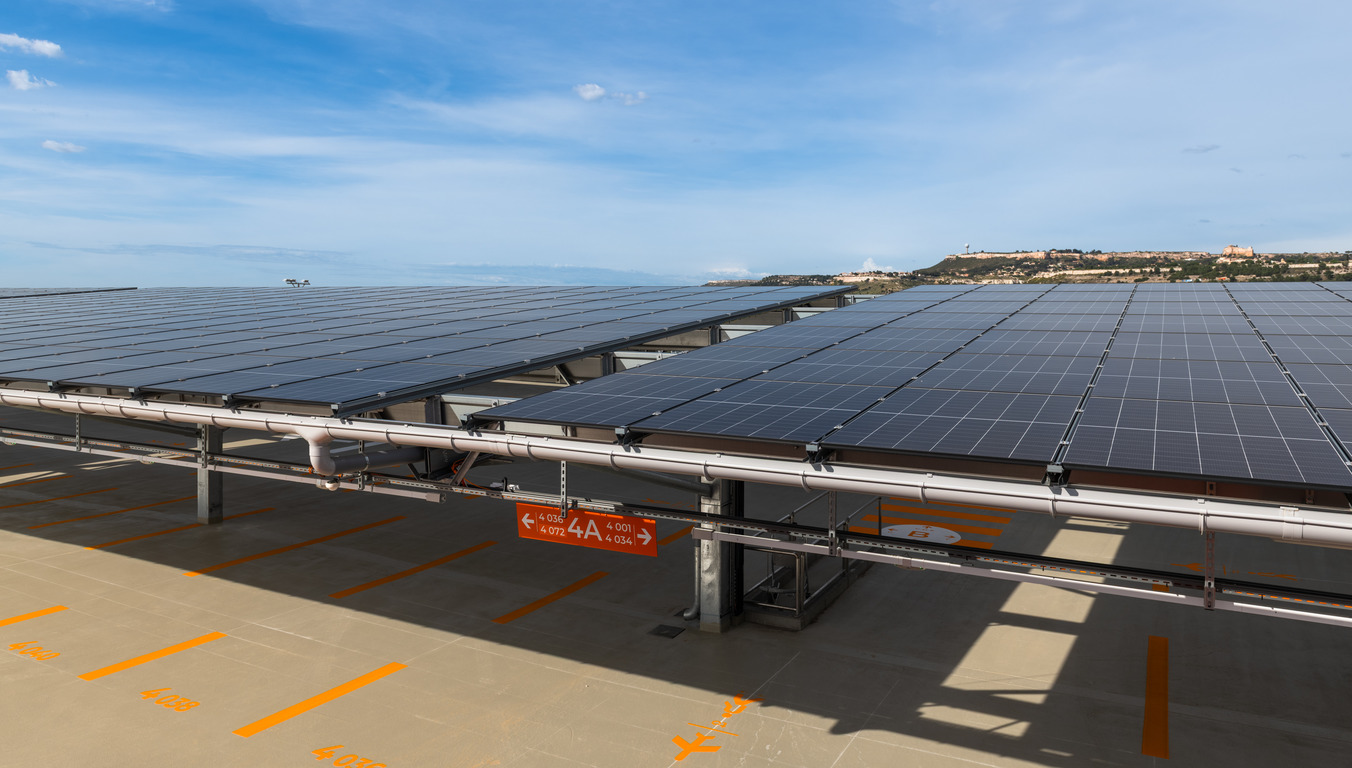
Behind the opening of the P3 parking facility, Aéroport Marseille Provence is not merely addressing a capacity issue. In its own way, it is also illustrating the contradictions of a contemporary airport: welcoming ever more passengers, working within increasingly scarce land resources, and at the same time reducing its energy dependence.
On 19 May 2026, the commissioning of P3B comes at a pivotal moment for the Provence airport platform. P3B is not being introduced into an unchanged landscape. It forms part of a broader reconfiguration of the parking offer, against a backdrop of the forthcoming partial closure of P2 as part of Terminal 2 modernisation works, the demolition of the upper level of SuperEco, and the future arrival of the cable link, which will affect the capacity of P5. In short, this is not about simply adding more spaces, but about redesigning overall capacity.
The decision to build a four- or five-level structure also says something about the times we live in. Land has become a scarce resource in a world where soil sealing must be reduced as much as possible, and where Aéroport Marseille Provence has even set itself the goal of re-vegetating 5,000 m² of land by 2030.
Beyond Parking, Another Guiding Principle: Energy
However, P3B is not merely a parking structure. It also completes a photovoltaic trio deployed across the P4, P3A and P3B parking facilities, with a straightforward ambition: to turn sealed ground into a useful surface, and the parking facility into a production asset as well as a service for passengers.
With the P3B solar canopies, the airport is expected to reach nearly 4 GWh of annual photovoltaic production, equivalent to the electricity consumption of around 1,000 households. One notable feature is that all of the electricity produced is consumed on site, representing around 20% of the airport platform’s electricity consumption. In an environment where energy costs have become a strategic issue, self-consumption is no longer symbolic; it is becoming a lever for economic control.
“Producing and consuming our energy on site means turning a land constraint into a useful resource,” summarises Julien Bastid, Head of Prevention & Energy at Aéroport Marseille Provence. These figures alone are not enough to transform the energy model of an airport, but they do mark a tangible shift: that of an infrastructure seeking to produce an increasing share of what it consumes, with the ambition of reaching 35% by 2030.
That is precisely what makes this development significant: at Marseille Provence, modernisation is no longer measured solely in traffic growth or additional capacity. It is also reflected in the way the infrastructure is attempting to reconcile growth, restraint and cost control within a single development strategy. “The challenge is not simply to create spaces, but to ensure that every square metre of already sealed land delivers several functions at once,” emphasises Julien Bastid.